A Path Through the Jungle
“Walkways allow people to easily move throughout the landscape without trampling your plants. They provide direction through the garden, keep your feet dry, and reduce soil compaction in lawns and landscape beds.”
The quote above is from our University of Florida IFAS Gardening Solutions website, my bible in all things gardening. But gardening info to me is like reading a cook book: I read a recipe, close the book and adapt things my way (which explains why my muffins never rise, my ice cream or pies have no sugar, or my foods are far spicier than expected). Extend that proclivity to my gardening. I wanted walkways, but I didn’t want to plan anything. Don’t ask why. I just did. It seemed the thing to do. Early on, the lack of walkways meant that walking between the raised beds required a tightrope like placement of one foot in front of the other, because that’s all the room there was. And yes, I’d fallen over way more times than I will admit here – AND I am getting too old for such falls! Already regretting the lack of space between my beds, I guess I was hoping I could actually plan the remaining expansion of my growing areas. Back in Indonesia, I had laughed at my husband for his obsession with building paths through the jungle thinking what a waste of time it was. Whatever it was he knew then, I instinctively learned. Meanwhile, when it came to creating my new gardens in the front yard, I created a walkway along with the first bed walls. The backyard was another matter altogether.
I never considered walkways in the backyard until I bought a tiller. I have since learned that tilling the ground is frowned upon as something not to be done in Florida. Some say it compacts the soil by exposing it to air and water while others say it scatters weed seeds. Regardless, I had decided with my permaculture background in Indonesia, my collected trash bags of leaves, my loads of mushroom compost and mulch, I was more than capable of planting in ground rather than in raised beds.
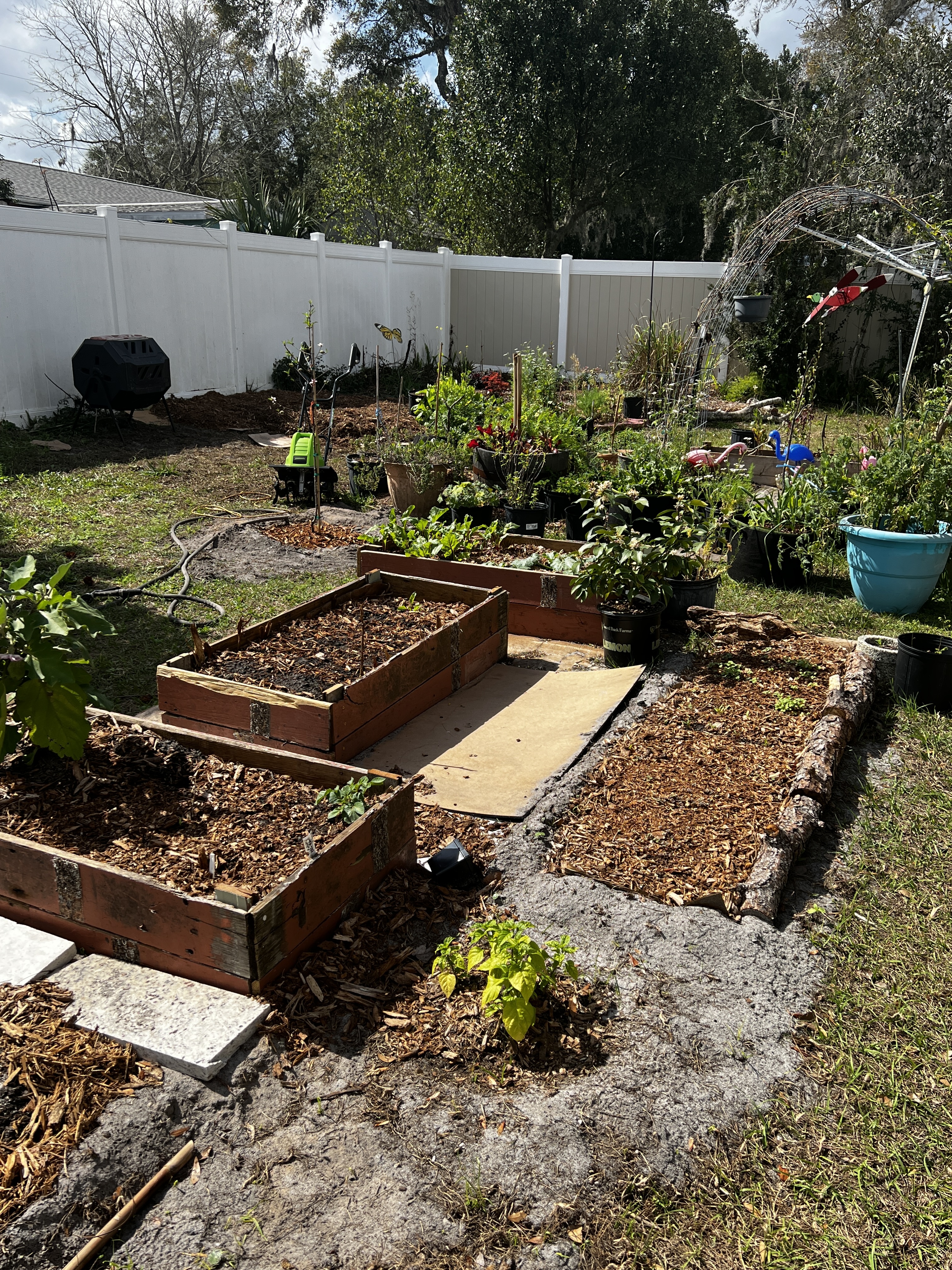
While Trevor (my first not-quite-worked-out Tinder match) recommended tilling instead of creating raised beds, I didn’t run out to investigate tillers until Jamie also said her family of intrepid gardeners used tillers for in ground planting. I had met Jamie at a local gallery opening. She was a lone female there, as was I while waiting for my friend Kat to arrive. I started talking with her and we quickly discovered our houses were a short walk apart. We met regularly for tea, a chat, a walk after that first meeting. Jamie gave me valuable advice on how to till, why to till and which tiller to buy at Lowes. In turn, I advised her to use dating apps. For a few months we had a real laugh over dating, once even discovering we had met the same guy, who we both rejected as too weird. Jamie had better luck with on-line dating than I did – or was she just less picky. Once she got a boyfriend, however, she dumped me as a friend. Or I think she did. She stopped replying to texts. I saw her again at another gallery opening with her new boyfriend. She seemed uncomfortable with my attempt to chat and did not even introduce him to Kat and I. Yet another Florida friendship fail for reasons I don’t understand.
With this new ability to till the ground and add lots of amendments to it, I was much freer to expand my growing area every which way – and I did! The first plot I tilled was just to the right of the red beds. I tilled just to the point where the sand turned yellow instead of the pale gray – about 4 to 6 inches below the grass. I had heard at a Master Gardener lecture (second Tuesday of every month at our local library) that worms loved newspapers so everything I clear now I cover first with our local weekly, the Beacon. Then I add whatever organic material I have on hand, on top of that I add the mushroom compost. Then add seeds (mustard greens and chilies in that first in ground bed) and later, mulch when the seeds have sprouted. Whether or not this approach has merit in the real world, I wouldn’t know. I know it works just fine and my vegetables mainly thrive.
But not always.
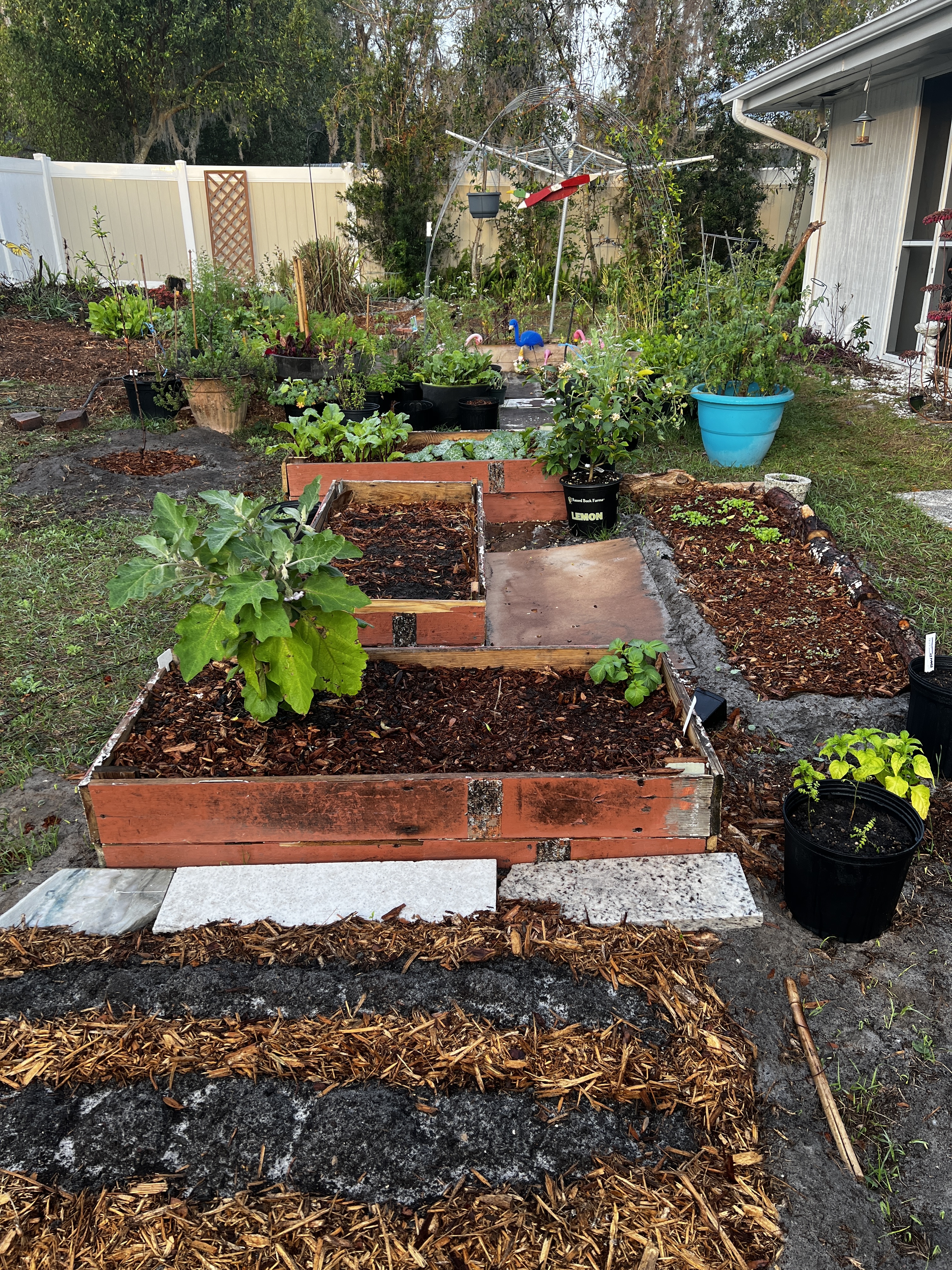
I next tilled the bottom section just east of the red beds. The plan was to grow potatoes since I had found some that had sprouted in my pantry. After reading up on the process, I created mounds and planted the sprouted spuds. Yes, I cut the potatoes and allowed the cuts to dry out in the pantry before planting them. Most never sprouted above the ground. The few that did most certainly gave me lots of potatoes but why some did and most didn’t, I still do not know. Sweet potatoes were a completely different matter. They were so easy to grow!
Next I wanted to create a flower bed to make sure those marvelous pollinators never dreamed of leaving my oasis for other gardens. I also wanted the Garden Club ladies to admire my handiwork and maybe even have my garden certified as pollinator friendly. If the ladies were ever to come to my place on a garden visit, I had to have safe paths for them to walk on. More than a few of them were not that stable on their feet and I wanted to make sure my place would be safe for them to traverse.
One day on Marketplace, I saw someone selling more than 200 used pavers for $50 and it was right here in Deland. I texted immediately and when she replied, I drove right over not wanting to miss out. The pavers were not stacked conveniently in a corner. They were all over her yard, in the ground, covered by shrubs and vines and weeds. That didn’t bother me at all as I gladly dug through all that debris to collect those marvelously cheap pavers. I was in heaven digging, hoisting, carrying, loading them into my Tesla. Once the back of the car was full, she said she’s fine with my coming and going as I pleased. It looked like some five or more trips back and forth. I asked Jim, my 80 year old neighbor, if he would loan me his truck.
That afternoon we drove back there to collect the rest of the pavers. As Jim and I dug around the yard, we kept finding more. In a few hours of nonstop digging and carrying, we actually filled the back of his pickup truck with way over the 200 she had guessed were there. I was giddy with happiness – which in retrospect should be worrying, but it’s not. Just yesterday I collected a pallet of used pavers on Hill Ave. requiring six trips in my Tesla. Last week I drove out to Debary for yet another Marketplace find of 100 pavers, following two trips a week before to Hontoon for a small load of 16×16 stepping stones. At least in these recent hauls, the sellers were male and happy to help me load them into the car. Of course no one is ever available to help me unload them. Just as well since having help would require I know what I’m doing enough to guide others. That ain’t gonna happen as I depend on ‘feeling’ for placement of walkways. At least, I have also learned to leave sheets in the car to collect dust and protect from scraping the cloth lining in the trunk. People constantly chastise me for using my Tesla like a pickup truck.
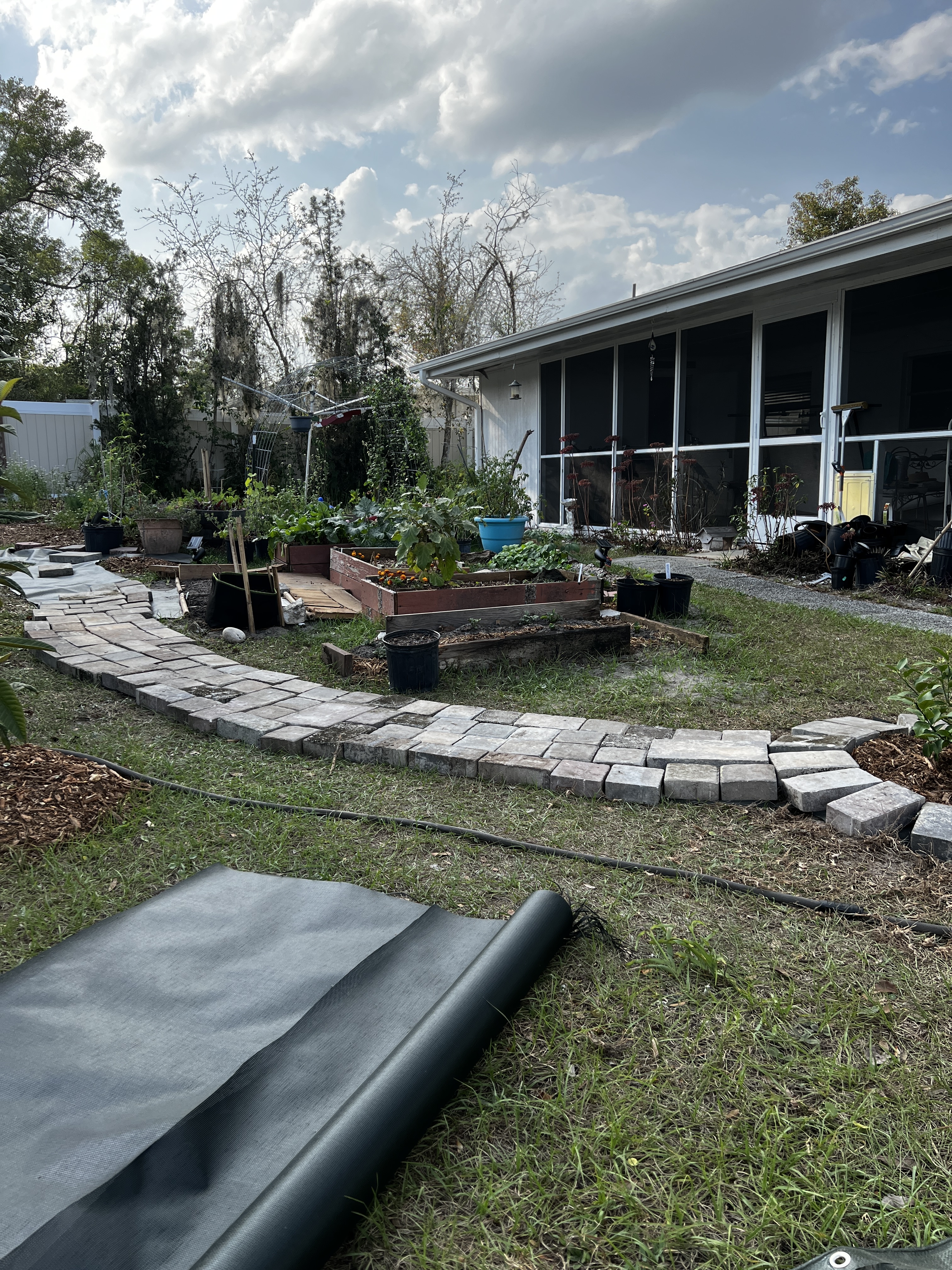
Once Jim and I arrived at my house, and he backed the truck up to my garden gate, he sensibly bid me goodbye and walked home saying I can take my time unloading the truck. It took two days to unload because it seemed stupid to unload, stack, then move them onto a path I would create. Instead, I dragged them two at a time (depending on how heavy they were – sometimes one, sometimes three) and began my great stone roadway.
I was clever this time and would use the weed block I still had left over from a previous dumpster dive. I cut it into long narrow strips and placed the pavers on top. Why i chose to begin the path at the Meyer lemon tree and not someplace functional reveals how my thoughts were on being (what I thought was) smart (weed block!!), and keeping the path attractive and creative, rather than useful.
The path then meandered over to the composter, past the not yet planned flower bed, and diverged around the peach tree and – much later – over toward my back door. A good path from my back door to the composter made sense at least, but I didn’t think of that until weeks – and another paver find – later. Placing a peach tree right in the middle of a pathway made no sense at all. Yet it took me almost a year to figure that one out as the tree grew in size. Now, as the tree is as tall as I am and its branches reach out over the path, I need to turn sideways to pass it, afraid of knocking off the buds or young peaches before I get to eat them. Some people learn slowly. Very slowly.
I’d tilled a big plot just to the left of the path and peach tree to create a flower bed in an area I figured wouldn’t get burned by full sun thanks to the camelia trees that came with the house, and the fence. I was still wanting to put into practice all I was learning at the Garden Club. I’d picked up a few flowering things at Lowes to plant there but none survived long. I had tried downloading a Florida Native Plant app to look up what I’d find at Lowes, but quickly lost patience as nothing matched. Sure Lowes carried plants with the same name as our natives, but they were different varieties not at all suited to our climate and fauna. There had to be a better way! Luckily a Master Gardener plant sale was coming up. In time I would learn that there too information was not always correct and that the term native is used too loosely.
Learning to garden is so like learning a foreign language. We think we know some words but in time they take on completely new meanings. Early on we think we know what we’re talking about. It’s only much later we realize how naive and ignorant we have sounded.
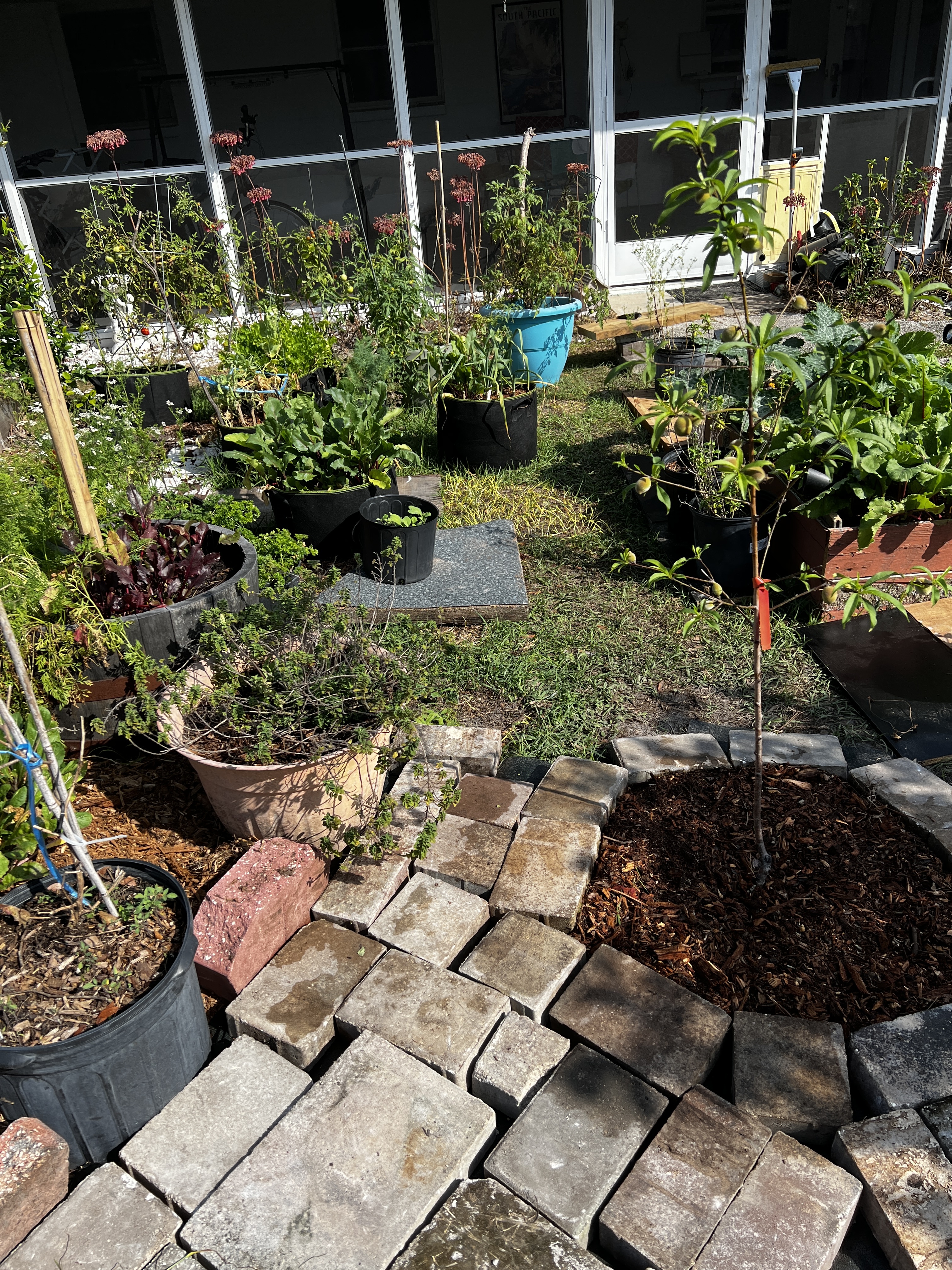
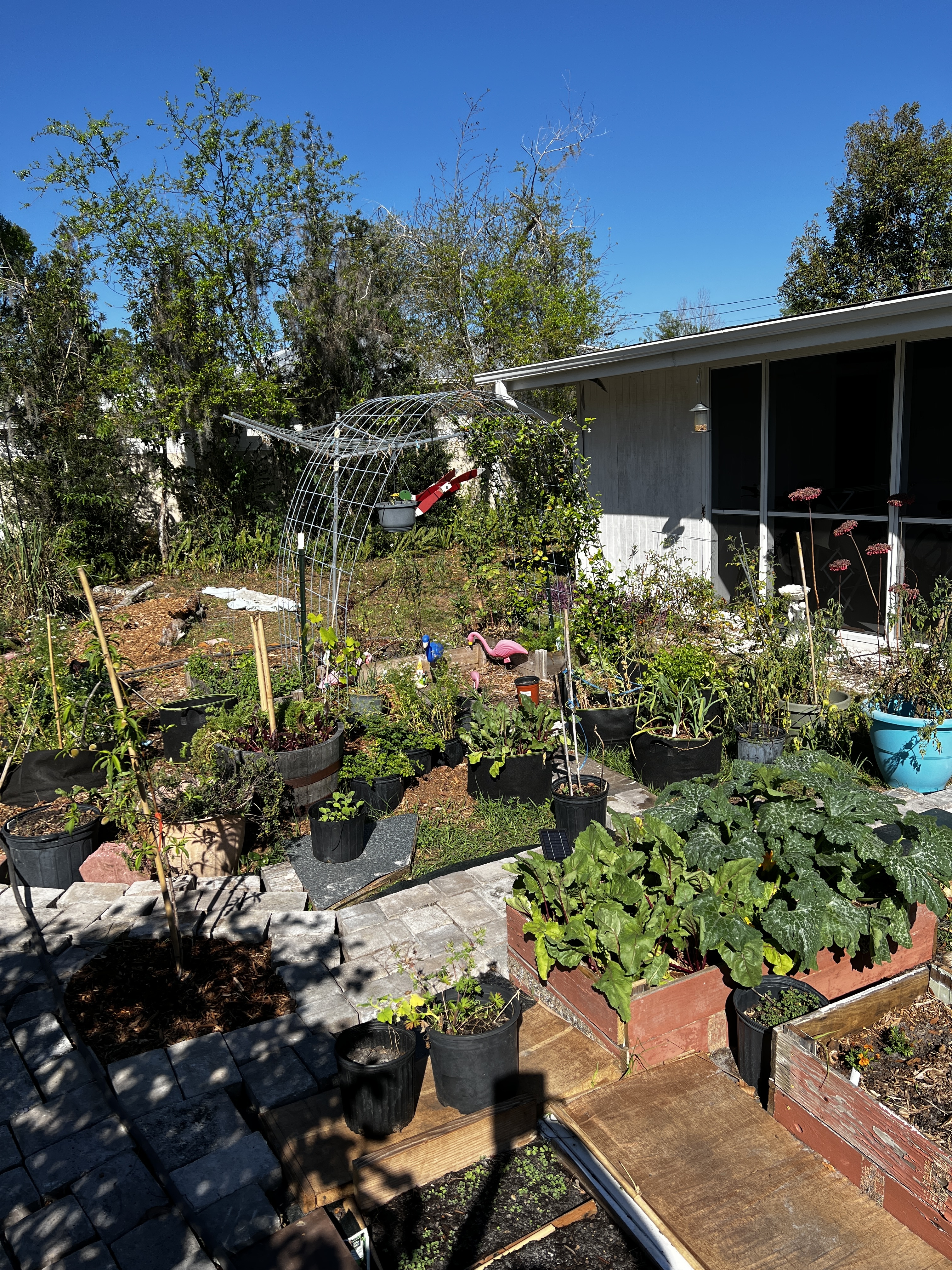
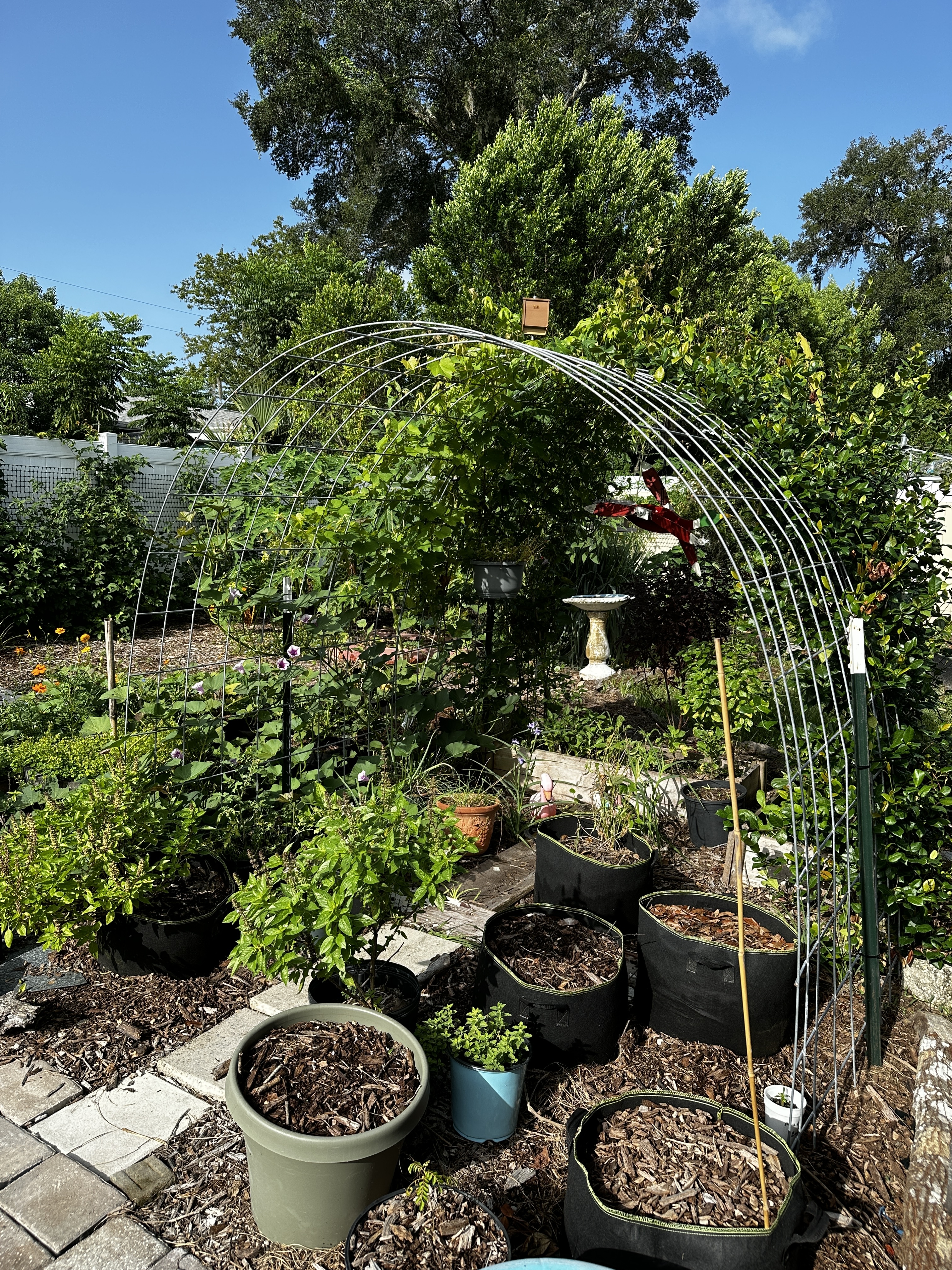
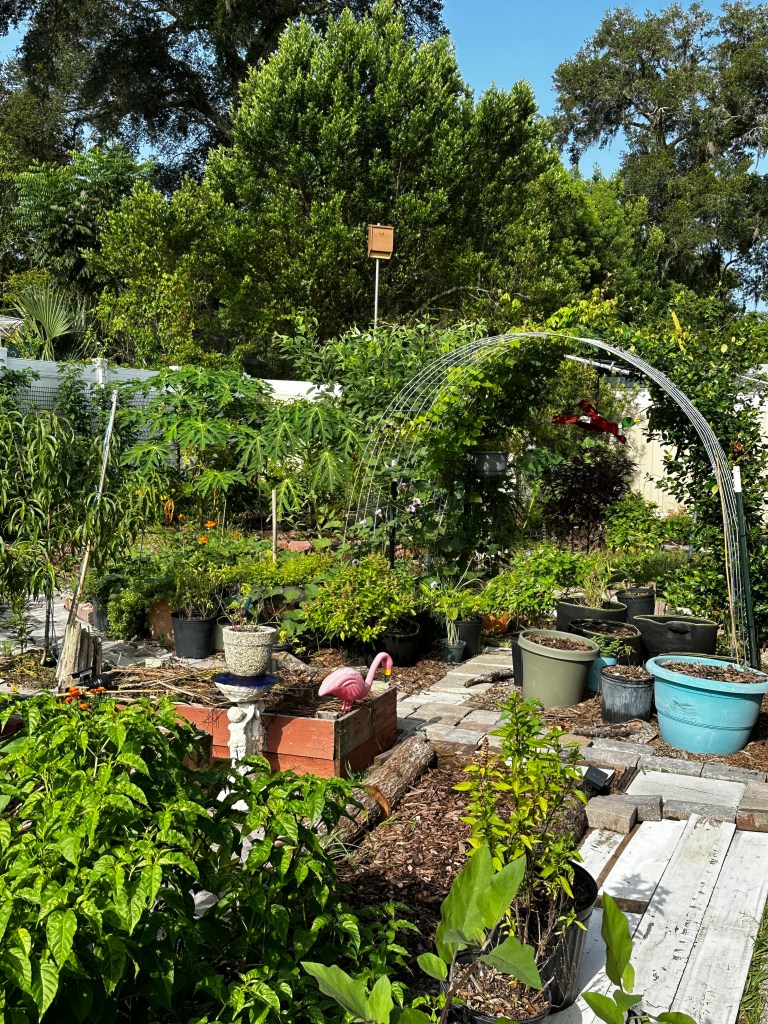
When my neighbor Jim came back a few days later to get his truck, I couldn’t wait to show him my gorgeous path!
“It’s so ugly!”, Jim said. He didn’t appreciate my creativity!

I just laughed and continue to gush over my beautiful accomplishment. Almost a year later, my arms still aching from that exertion, I realized the walkway was just too narrow and my gorilla cart would not traverse it. I had to widened that path by pushing the thick mulch another 10 or so inches over, picking bricks (before I’d found more on Marketplace) from elsewhere in the garden, and moving them. It would seem I am forever placing, replacing, moving, buying materials, and redesigning my paths. That line in all the gardening “how to” books that says step one is to design your garden……. One day I will learn what that actually means. But then, with my never-ending education and the constant renewal of what I had previously thought I knew about gardening, it would seem that redesigning, redeveloping, reorganizing the garden is destined to be my fate. Hence all those trips around town to pick up even more – but cheap! – used pavers.
Shortly after widening the paths, I finally realized starting by the lemon tree and curving toward the peach tree was just wrong. So yep, there I was again with a new stash of pavers moving the path away from the lemon tree and over toward the gate. I think I finally have it right now. I just wish I hadn’t put the peach tree right in the middle. Nothing I can do about that now without digging up my native flowers.
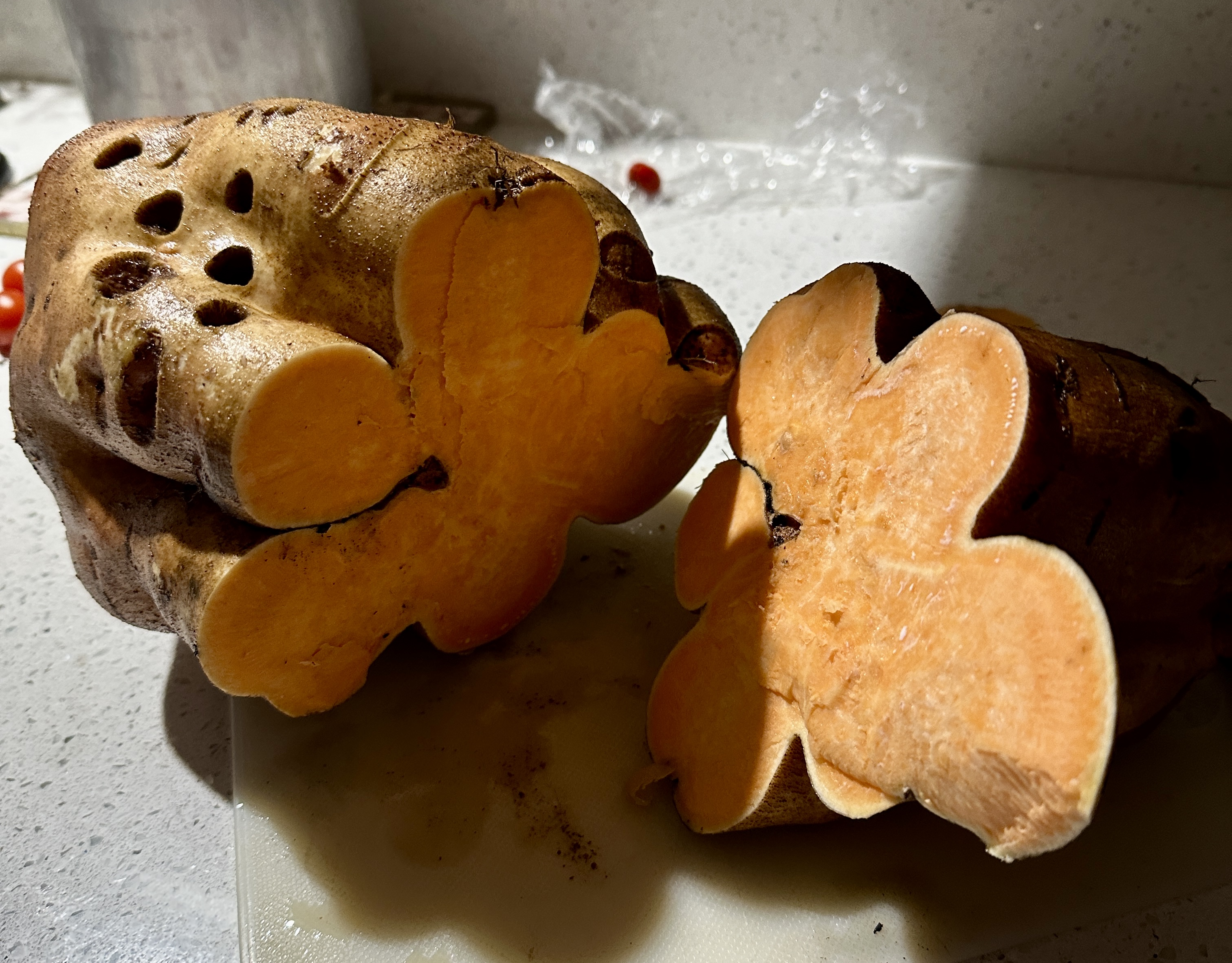
In addition to pavers, I have been collecting scrap wood and assorted building materials to use in lieu of pavers when they were hard to get. It would seem I am not the only person in town looking for bargain garden materials on Marketplace. You need to be quick on the mark to get the goods. Yet, as I pushed aside the mulch to place the bricks and/or wood, I discovered caches of sweet potatoes planted who knows when. How was I to know that anywhere the vines touch the earth and root, more potatoes will grow? Following the vines, I discovered 10 pound potatoes that have likely been growing since I first began planting the garden! They are undoubtedly ugly but they are surprisingly delicious too!
The moral of the story then is despite all the errors and endless extra work I give myself, the rewards too are endless!
Until next week!
 Laine Berman
